Toy Triple - 3D Match Puzzle
- 4.6
- Rating
- 1.00M
- Installs
- Free
- Price

 Analysis by App-foxy
I opened Toy Triple - 3D Match Puzzle expecting a light board game, and that is exactly where it fits best: a casual matching game built around arranging three identical three-dimensional objects. It is easy to understand, quick to start, and more relaxing than competitive. The main appeal is not a complicated rule set, but the small satisfaction of clearing a crowded play area one group at a time.
That simplicity makes it a comfortable choice for a first-time player. You do not need experience with traditional board games, fast reflexes, or a long uninterrupted session. I can imagine using it while waiting for an appointment, winding down before bed, or taking a short break from work. At the same time, the game is more interesting than a basic tap-to-match toy because the objects occupy space, overlap visually, and require attention to what is available now versus what may become available after a move.
What the game feels like once you begin
The core loop is straightforward. I look across the puzzle area, identify three matching objects, and select them to remove them from play. The challenge comes from noticing the right objects in a busy three-dimensional arrangement and avoiding choices that leave the remaining pieces awkwardly blocked or difficult to read.
You May Also Like

 Blood Strike: 2.5 Anniversary
Blood Strike’s Loadouts Turn Every Drop Into a Tactical Gamble
A close look at Blood Strike’s custom loadouts: how fast access to signature weapons reshapes its battle royale rhythm, rewards preparation, and narrows the gap between fights.

 Pandora - Music & Podcasts
Pandora’s Music Is Easy to Start, but Harder to Recover
Pandora’s strength is its low-effort path from a seed to a station. Its weak spot is how much confidence it asks you to place in connection, setup, and quiet recovery.

 8 Ball Pool
 Is Built on Rivalries, Rematches, and Routine
A close look at the rivalries, rematches, shared routines, and unanswered safety questions that turn a quick pool match into a persistent mobile community.

 Samsung Music
’s Quiet Strength Is Playing What You Already Own
Its reach comes less from spectacle than from dependable access to a personal library. That simplicity is both the app’s strongest retention engine and its ceiling.

 AccuWeather: Weather Radar
AccuWeather Review: A Quick, Clear Forecast for Everyday Decisions
For everyday plans, the best forecast is the one you can understand quickly. AccuWeather makes rain timing, radar, and local conditions easy to act on, with a few trade-offs.

 Hill Climb Racing
Why Hill Climb Racing Still Turns Crashes Into One More Run
A tiny car, a bumpy hill and one more upgrade: Hill Climb Racing keeps resurfacing because its simple chaos makes every near-miss feel personal.
More From Our News Desk



This is a board game in the broad mobile sense rather than a traditional digital version of chess, checkers, or a card table. There is no need to learn a long rulebook before playing. The board itself teaches the routine: scan, choose a matching trio, clear it, and reassess the new layout. That makes the game approachable for children and adults alike, which fits its Everyone content rating.
My first useful piece of advice is not to tap the first familiar object I see automatically. I get better results by taking a brief visual inventory of the whole board. A trio that looks convenient may be sitting in a position that hides another useful piece, while a less obvious group can open a much cleaner route through the puzzle. This small pause turns the game from random tapping into a gentle planning exercise.
The presentation also affects how comfortable the experience feels. Three-dimensional pieces are more visually engaging than flat colored tiles, but they can make quick scanning less precise. When several objects have similar shapes or colors, I slow down and compare details instead of relying on a glance. That is especially helpful on a smaller phone screen, where the board can feel more crowded than it would on a larger display.
Skylink Studio has positioned the game as a free download, so it is easy to try without making an immediate purchase. The current version is 6.7.8, and the game runs on devices using Android 7.0 or later. Those details matter to someone using an older phone: the minimum operating-system requirement is not especially demanding, but it is still worth checking before spending time looking for it.
The game has attracted over one million installs and holds an average rating of 4.6 from roughly twenty-one thousand ratings. I would not treat those figures as a guarantee that every player will enjoy it, but they do suggest that the basic combination of relaxing presentation and simple matching has found a substantial audience.
Getting comfortable before the first puzzle
After installing, I recommend starting with the expectation that the early levels are for learning the visual language, not proving how quickly you can solve anything. The important first step is to understand how the game presents a selectable object, how a chosen piece is marked, and what happens when the third matching item is selected. Once that rhythm is clear, the rest feels much less mysterious.
I also prefer to play the opening stage with the phone held steadily and the screen free from distractions. This sounds obvious, but three-dimensional matching depends on visual comparison. Reflections, similar colors, and overlapping pieces can make a rushed first attempt feel harder than it really is. A calm setup gives the board a fair chance to communicate what it wants you to notice.
The free-to-play structure is something I keep in mind from the beginning. Optional purchases range from $0.99 to $89.99 per item. That wide range means I would not hand the phone to a child without discussing purchase controls first. For my own use, I treat paid options as optional conveniences rather than part of the basic reason to install the game. The free entry point is useful, but it is still sensible to avoid tapping through purchase prompts without reading them.
A practical setup habit is to decide what kind of session you want. If I have only a few minutes, I play one puzzle and stop rather than trying to turn a short break into a long run. If I want a more focused brain exercise, I remove background distractions and deliberately study the board before each selection. The same game supports both moods, but the experience changes depending on whether I approach it as idle entertainment or a concentration task.
The first meaningful success
The first satisfying moment arrives when the matching rule stops feeling like a search problem and starts feeling like a sequence. I find a visible trio, clear it, and immediately notice that the remaining layout is easier to read. That is the point where the game becomes more than a collection of objects. Each successful match changes the information available for the next decision.
For a first attempt, I would use a simple three-pass method. On the first pass, I look only for an obvious trio. On the second, I check whether any pieces are partially hidden or visually easy to confuse. On the third, I choose the group that seems most likely to expose useful pieces rather than merely the group that is closest together. This method is reassuring because it provides a repeatable process without making the game feel like homework.
One of the less obvious skills is managing attention, not just recognizing objects. When I stare at the same cluster for too long, I begin to overlook shapes that are slightly outside the center of the board. A short reset helps: I look at the edges, then the middle, and then return to the pieces I was considering. That habit is particularly effective when the board contains many decorative or similarly shaped items.
I also avoid committing to two matching pieces unless I have a reasonable idea where the third one is. Selecting partial groups can make the board harder to read and may leave me with a less flexible arrangement. The better approach is to treat a pair as a clue, not a completed plan. I search for the third item, consider what will be exposed after clearing the group, and only then commit.
This is where the game can quietly train visual sorting and short-term planning. It does not replace a dedicated logic course, and I would not describe every puzzle as deeply strategic. Still, the need to remember where matching pieces are located, compare similar objects, and choose an efficient order gives the short sessions more substance than passive scrolling.
Where new players may hesitate
The most common confusion is assuming that matching objects only count when they are immediately adjacent. My experience is that the important question is whether the game recognizes three identical pieces as a valid group, not whether they form a neat line. I therefore scan the entire playable area instead of limiting myself to neighboring objects.
Another source of hesitation is the three-dimensional view. A piece that appears visible may be partly obscured by another, and an object that looks unavailable at first can become useful after a different group is removed. I try not to judge the board from one fixed glance. After every successful match, I pause and read the new arrangement again, because the best choice can change as soon as the visual clutter decreases.
Similar-looking objects can also create false confidence. I have learned to compare the full design rather than matching only by a broad color family. When the game presents several items with related tones or shapes, I check small visual distinctions before selecting. This reduces the frustration of building a group that I assumed was correct but that does not behave as expected.
Some players may wonder whether the game is suitable for children. The Everyone rating makes it broadly accessible, and the rules are simple enough for a child to understand with minimal explanation. My caution would be less about the puzzle itself and more about the free-to-play environment. Since in-app items are available at different prices, I would use the device’s purchase protections and supervise younger players, especially if the phone is shared.
Another reasonable question is whether it works for people who dislike timers or pressure. I found the game most appealing as a calm matching experience, but individual levels can still feel mentally demanding when the board is crowded. Anyone seeking a completely passive activity may prefer a simple idle game or an endless visual toy. Here, the player has to look carefully and make decisions, even when the overall tone remains relaxed.
Small techniques that make later boards clearer
My favorite technique is to classify the board in layers. I first identify pieces that are completely exposed, then pieces that appear partly covered, and finally the objects near the edges that are easy to ignore. Clearing exposed groups can reveal new options, but sometimes an edge piece is the key to preventing the board from becoming visually tangled. Thinking in layers helps me avoid focusing only on the center.
A second technique is to preserve flexibility. If I can choose between two valid trios, I usually select the one that removes the most visual obstruction or leaves several obvious possibilities behind. This is a more useful goal than simply choosing the nearest group. It also makes failure feel more informative: if the board becomes confusing, I can identify that I spent a move without improving the layout.
A third technique is to use a deliberate stopping point. When I notice myself tapping quickly or selecting pieces without checking the whole board, I stop for a few seconds. This is not merely about accuracy. It keeps the game in the relaxing category for me instead of turning a short break into an irritating battle with my own impatience.
These habits reveal the main trade-off in the design. The game is accessible because the rules are simple, but the visual board can still demand concentration. Players who enjoy spotting patterns and organizing clutter will probably appreciate that balance. Players who want a completely predictable match-three format, where every move is obvious and the board is flat, may find the three-dimensional presentation less comfortable.
How it compares with familiar alternatives
Compared with a standard match-three game based on swapping colored gems, this title feels slower and more observational. There is less emphasis on creating chains through rapid exchanges and more emphasis on locating identical objects in a layered space. I prefer this approach when I want a puzzle that lets me pause between decisions rather than rewarding constant speed.
Compared with classic board-game apps, it has a much lower learning barrier. I do not need an opponent, a long session, or a detailed understanding of strategy. That is a strength for casual use, but it also means the game is not the right substitute for a serious competitive board-game experience. Someone looking for deep multiplayer planning, rich narrative, or a campaign with complex rules should choose a different category entirely.
It also differs from ordinary hidden-object games. The purpose is not simply to locate one unusual item among many. I need to assemble groups of three and think about the order in which I remove them. That extra step gives the search a useful consequence: spotting an object matters because it may influence the next several choices.
For a daily brain break, I find the game more engaging than a purely decorative puzzle, while still being less demanding than a dedicated strategy title. That middle ground is its strongest identity. It is a good fit for someone who wants a small mental task with a friendly board-game feel, but not for someone measuring enjoyment by story depth, competitive ranking, or elaborate customization.
Who will enjoy it, and who should pass
I would recommend it to players who like sorting, matching, and visual organization. It is particularly suitable for short sessions because the central action is immediately understandable. Adults can use it as a screen break that still requires attention, and families can introduce the basic idea without explaining complicated controls.
I would be more cautious about recommending it to anyone who becomes frustrated by visual clutter or has difficulty distinguishing similar objects on a small display. The three-dimensional style is the reason the game feels distinctive, but it is also the source of much of its friction. A flat tile-matching game may be a better choice if clarity and speed matter more than spatial presentation.
It is also not my first choice for players who need a strong sense of progression beyond solving one puzzle after another. The appeal is in the repeated act of examining, matching, and clearing. If that loop does not feel satisfying within the first few attempts, extra play is unlikely to change your opinion. The game is honest about its core pleasure: it offers a focused activity, not a large adventure.
My recommendation after spending time with it
Toy Triple - 3D Match Puzzle works because it gives a familiar matching idea a more tactile, spatial surface. I like that I can understand the objective almost immediately, yet still improve by learning when to scan, when to wait, and which group will make the next decision easier. Those small choices give the game enough depth for repeated casual sessions without turning it into a demanding commitment.
The limitations are equally clear. Visual similarity can slow down recognition, crowded arrangements may require patience, and the free-to-play model includes in-app items from $0.99 to $89.99 per item. I would approach it with purchase safeguards enabled and with realistic expectations: this is a relaxing puzzle board, not a full strategy game or a competitive tabletop replacement.
For a first-time player, my suggested path is simple: install it, play the opening puzzle slowly, search for a complete trio instead of tapping isolated pairs, and reread the board after every clear. Once that routine becomes comfortable, try choosing matches that expose more of the layout rather than merely removing the easiest objects. That shift from quick recognition to thoughtful ordering is where the game becomes genuinely satisfying.
Skylink Studio has made a free board game that is easy to approach and pleasantly focused. I would recommend it to a friend who wants a quiet way to exercise visual attention during spare moments, especially if they enjoy organizing messy spaces and spotting patterns. I would skip it only if the three-dimensional board style feels tiring or if I wanted competition, story, or complex strategy. For everyone else, it is worth trying without pressure and judging after a few carefully played puzzles.
FAQs for Toy Triple - 3D Match Puzzle
01What is Toy Triple - 3D Match Puzzle, and how do you play it?
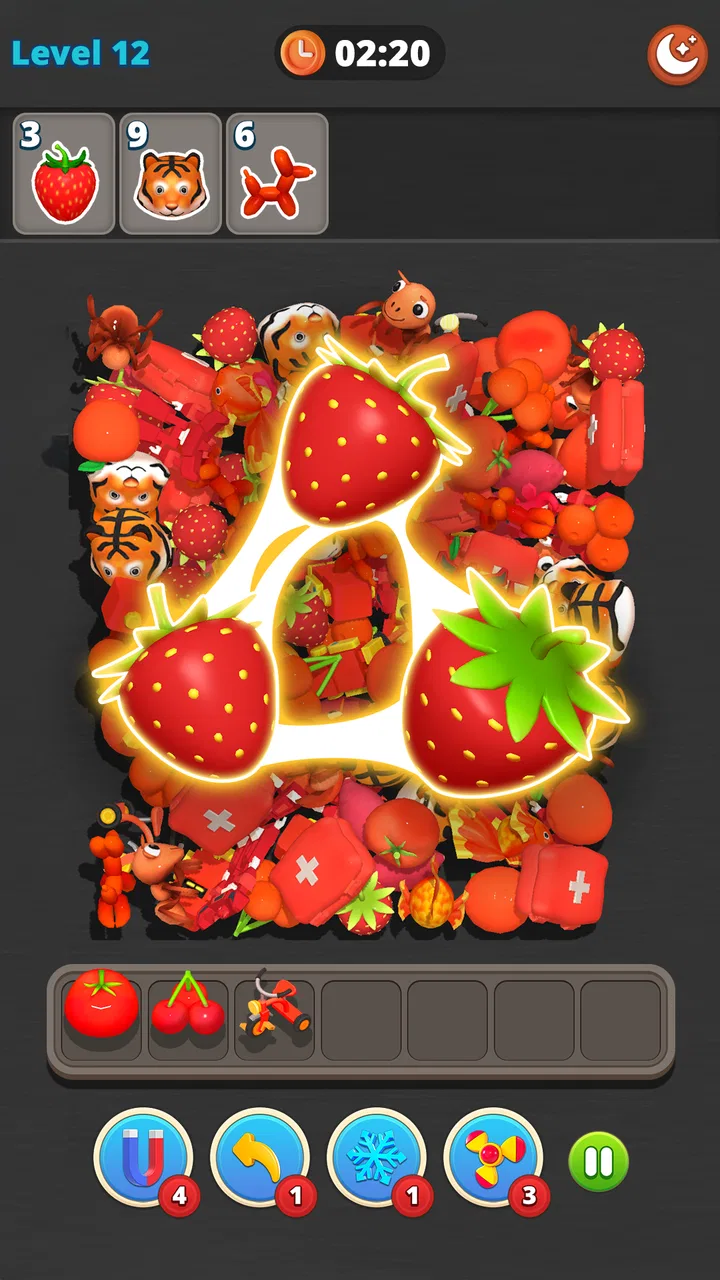
Toy Triple - 3D Match Puzzle is a casual matching game built around finding three identical 3D objects and combining them to clear the board. After starting a level, you tap visible toys and place them in the collection tray at the bottom of the screen. Matching groups disappear, while unmatched items occupy limited spaces, so you need to plan your moves carefully and avoid filling the tray before completing the level.
02Is Toy Triple - 3D Match Puzzle suitable for children and casual players?
The game is easy to understand and uses simple tap controls, colorful toy designs, and short levels, making it accessible to casual players and families. However, some stages can become surprisingly challenging because objects overlap and the available tray has limited capacity. Parents should also review the advertising, in-app purchase, and device settings before allowing younger children to play independently.
03Does Toy Triple - 3D Match Puzzle require an internet connection?
Basic puzzle gameplay may be available without a constant internet connection, which is useful when traveling or playing in areas with weak reception. Nevertheless, certain features can depend on connectivity, including advertisements, rewarded bonuses, events, updates, cloud-related functions, or purchases. Availability may vary by version and device, so it is best to test the game offline after installation rather than assuming every feature will work.
04Are there ads or in-app purchases in Toy Triple - 3D Match Puzzle?
Like many free-to-play puzzle games, Toy Triple - 3D Match Puzzle may include advertising and optional in-app purchases. Ads can appear between levels or be offered in exchange for helpful rewards such as extra time, hints, or additional chances. Purchases may provide boosters or remove advertising, depending on the current version. Check the store listing and your platform’s payment settings before downloading.
05What should I know about difficulty, boosters, and progression?
Early levels generally introduce the matching system gradually, but later boards require more observation, memory, and careful tray management. Boosters or assistance tools can help when objects are difficult to reach or when the board becomes crowded, although they may be limited or connected to rewards and purchases. Progress is designed around completing levels, earning bonuses, and overcoming increasingly complex arrangements rather than fast reflexes.
Pros
- Relaxing gameplay suitable for short or extended sessions.
- Bright 3D objects make matching pairs easy to recognize.
- Progressive levels provide a steady sense of achievement.
- Simple controls are accessible for players of most ages.
- Offline play is convenient when no internet connection is available.
Cons
- Later levels can feel repetitive after extended play.
- Small objects may be difficult to select on smaller screens.
- Some challenges rely more on speed than strategic planning.
- Frequent rewards may interrupt the flow of a level.
- Device performance can affect smoothness on older phones.

Toy Triple - 3D Match Puzzle
Gallery